





Your content gets rejected, your assignment gets flagged, your article looks machine-written even when it isn’t. We tested Clever AI Humanizer against 23 alternatives to show you exactly how it performs.
In this review, we show you every feature, the full detection test data, a direct comparison with five competitors, and a clear answer to the question: Does it actually bypass AI detectors – or not?
What Is Clever AI Humanizer
Clever AI Humanizer is a free AI humanizer – one of the most tested data recovery tools on the market. The product operates in a completely different space, but the same principle applies: no paywalls, no ads, built for real daily use.
The tool rewrites AI-generated content at the structural level – not word-by-word swaps – so that the output reads as human-written and passes AI detection platforms. You paste your text into the left panel, the rewritten version appears on the right, and changed fragments are highlighted so you see exactly what the tool restructured.
Without registration, you get 1,000 words per run. After a free sign-up – no credit card required – the daily limit rises to 7,000 words, and you unlock content history. The monthly cap is 200,000 words. No subscription activates mid-process. No ads appear in the interface.
Key Features of Clever AI Humanizer
On the surface, Clever AI Humanizer looks like a standard tool of its kind. After testing it, several details stood out enough to deserve separate attention.
| Feature | What You Get |
| Three Writing Styles | Casual, Simple Formal, and Simple Academic modes produce measurably different detection outcomes. Casual mode delivered the lowest AI detection scores in every sample we ran – the platform marks it “Best score,” and our data confirms it. Formal and Academic modes serve structured contexts but trade some detection performance for tonal precision. You choose the mode that fits the content type. |
| Natural and Polished Output | The rewrite produces text with varied sentence length, no repeated structural patterns, and no broken syntax. Grammar averaged 92.6/100 across our test samples without any manual editing. The output does not require a cleanup pass before use. |
| Content History | Every run saves to a history panel with date, word count, and a snippet once you create a free account. We traced runs from several months back during testing – all intact, none deleted. For long-term projects, this removes the need to reprocess content you already handled. |
| Formatting Preserved | Headings, bold, italics, underline, bullet lists, and numbered lists all pass through the rewrite unchanged. Most comparable tools strip formatting on output and force manual reapplication. For structured content – blog posts, reports, assignments – this saves real time. |
| Multi-Language Support | The tool rewrites content in multiple languages, including French, Spanish, Italian, German, Dutch, Portuguese, and Polish. The interface is localized, so non-English users do not depend on browser translation. |
| Always Improving | Two tools – Grammar Checker and AI Paraphraser – are marked NEW in the navigation, which signals active development. The monthly word limit also increased from 120,000 to 200,000 words, visible on the current homepage. |
| No Ads, No Paywalls | The interface runs with no advertisements and no mid-process payment requests. You use the full daily limit without a premium upsell appearing after the first few inputs. |
The Clever AI Humanizer Platform
Clever AI Humanizer is not a single tool. The platform runs four distinct tools within a single interface, and each one covers a different stage of the content workflow. We show you what each tool does so you can see where it fits in your process.
Free AI Text Humanizer
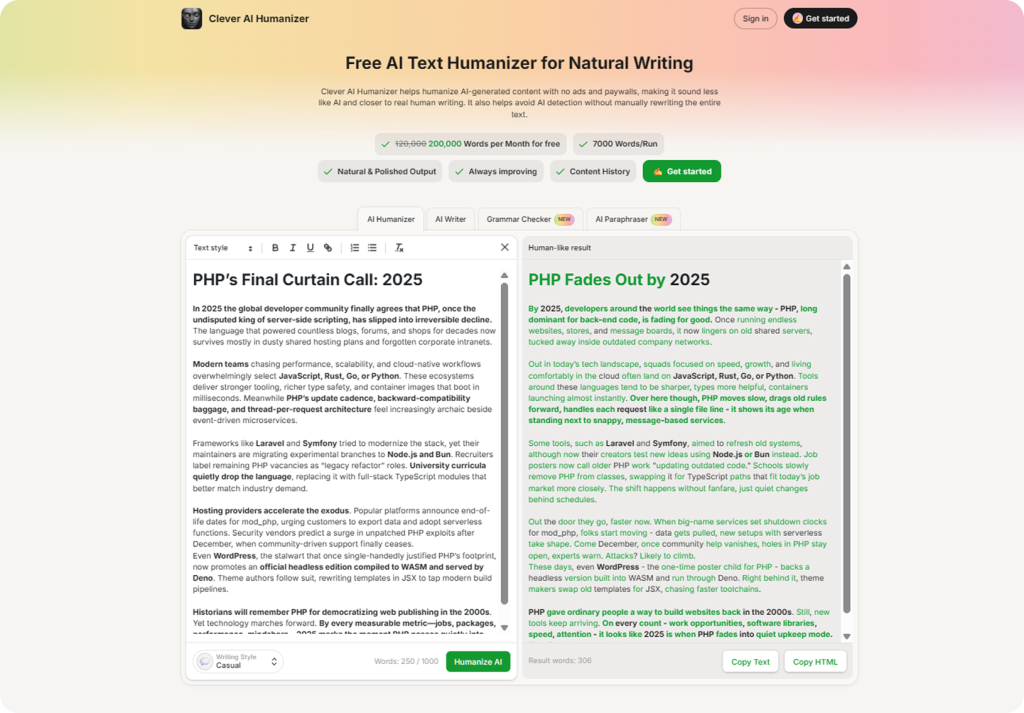
The core tool. It takes AI-generated text, restructures it at the sentence and pattern level, and returns output that reads as human-written. The interface shows two side-by-side panels – original text on the left, rewritten version on the right – with changed fragments highlighted in blue so you see exactly what shifted. Three writing styles are available: Casual, Simple Formal, and Simple Academic. All formatting – headings, bold, lists, italics – passes through the rewrite intact.
AI Writer
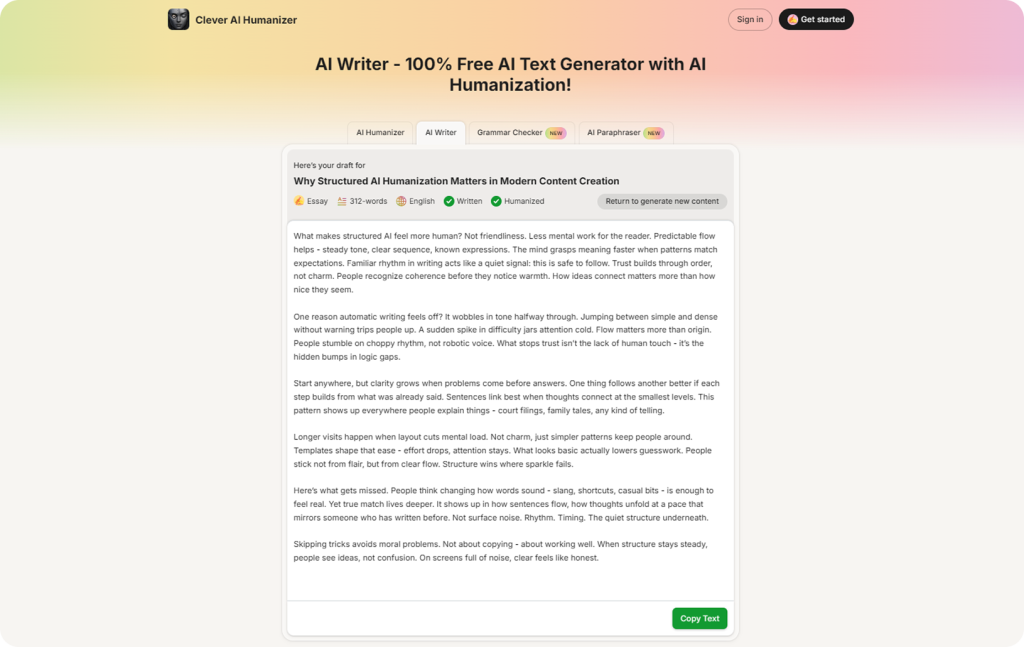
The free AI text generator produces original content and runs it through the humanization engine in a single operation. Three output formats are available: Essay, Blog Post, and Article. Word count ranges from 100 to 1,000 words. Writing style and language are both selectable before generation. The result arrives ready to use – no separate humanization pass needed.
Free AI Grammar Checker
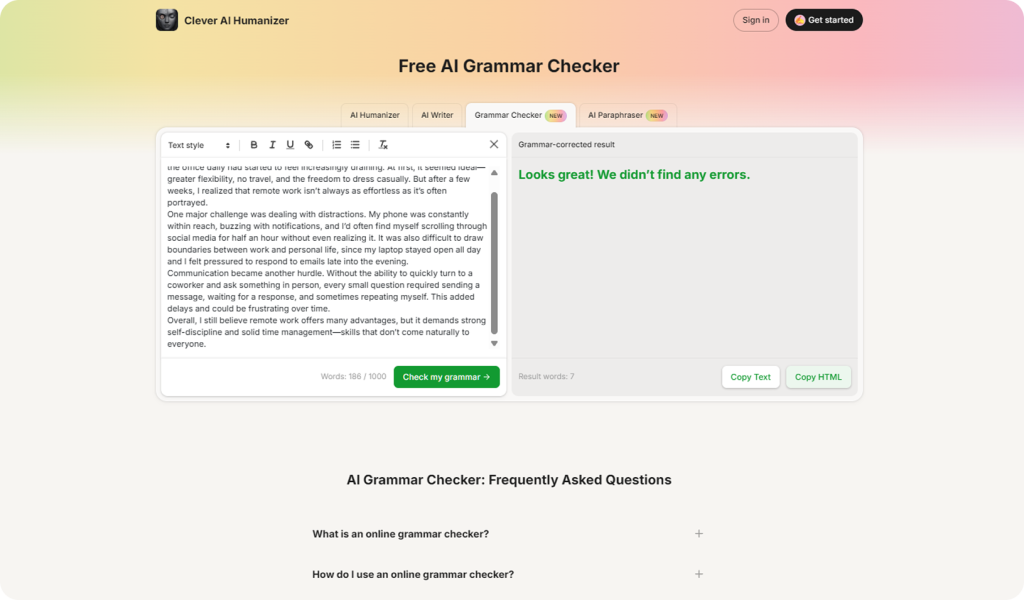
A free grammar correction tool that identifies errors, rewrites awkward sentence structures, and improves overall readability. Text input and file upload are both supported – DOCX and PDF formats are accepted. The tool covers multiple languages and works in mobile browsers. Marked NEW in the navigation.
Clever AI Paraphraser
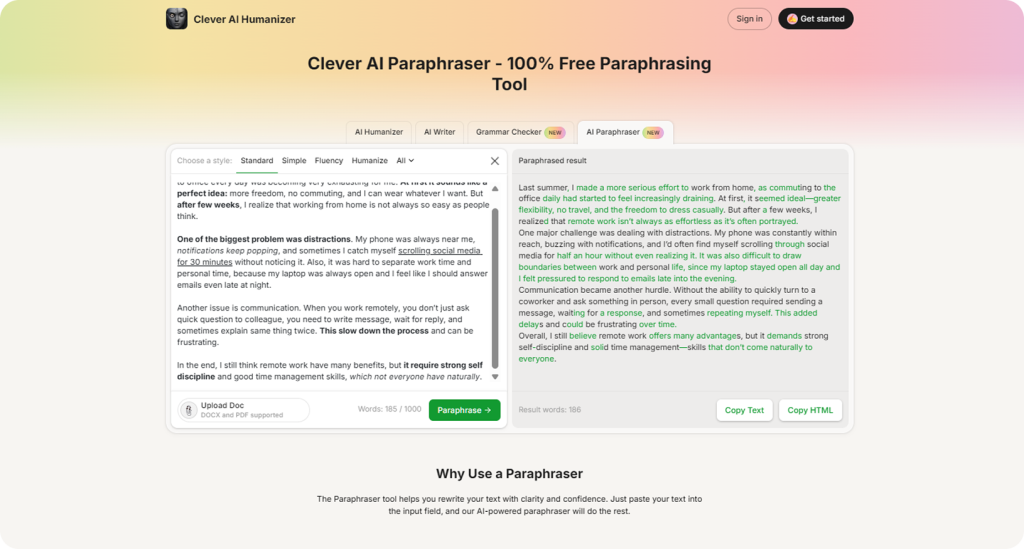
The paraphrase tool rewrites sentences for clarity and precision while keeping the original meaning intact. Four modes are available: Standard, Simple, Fluency, and Humanize. Input limit is 1,000 words per use; DOCX and PDF uploads are supported. Use this tool after the Humanizer when a specific phrase shifts away from its intended meaning after the structural rewrite.
How We Tested Clever AI Humanizer
With the platform covered, we move to the numbers. Here is our testing approach – repeatable and easy to verify, so you can run the same inputs yourself.
We generated three AI-written texts, each in the 400–650 word range, on distinct topics: artificial intelligence, sushi, and NFTs. All samples came from GPT models. We chose this length range because it is long enough to trigger the statistical pattern-detection logic AI checkers rely on. Samples under 100 words do not give detectors enough data to measure writing patterns meaningfully; the 400–650 range reliably surfaces the structural signals that separate AI from human writing.
For detection, we used two platforms: ZeroGPT and GPTZero. We scored every output on both and averaged the results. We used two detectors because, as University of Maryland researchers found, the same passage can pass one detector and fail another on the same day. A single-detector result would give you a distorted picture.
For grammar, we ran each output through a standardized grammar checker (0–100 scale) and averaged three scores per tool. We also read every sample manually to catch tone shifts that automated checks miss.
Scores reflect a single test run on approximately 400-word samples and may vary with different content types.
Test Results
| Metric | ZeroGPT | GPTZero | Avg Detection | Grammar |
| Before humanization | ~95% AI | ~92% AI | ~93.5% AI | – |
| After humanization | 4.9% AI | 4.0% AI | 4.45% AI | 92.6/100 |
All three texts started at 80–100% AI detection. After we ran them through Clever AI Humanizer, ZeroGPT and GPTZero landed in the 0–15% range on every sample, with an overall average of 4.45% AI. That result held across all three topics and both detectors.
The two detectors diverged on some samples. GPTZero flagged one rewritten text at 14% while ZeroGPT scored the same text at 0%. That variance is expected – different platforms measure different signals. Neither result is wrong.
Casual writing style produced the lowest detection scores in every sample. Formal mode raised those numbers slightly; Academic mode pushed them further up – heavier vocabulary and longer sentences read as more AI-like to both detectors. If your goal is to pass AI detectors, Casual is the mode to use.
AI detection is not an exact science. Different platforms apply different scoring models, and the same text can pass one detector and fail another on the same day. There are documented cases of human-written content being flagged as AI-generated – a false positive problem that researchers and journalists have covered in detail. We raise this not to dismiss detection tools, but to frame the numbers that follow accurately.
A note on responsible use before the AI Writer results. We do not support using fully AI-generated content for unmodified academic or professional submissions. The tests below used 100% AI text for measurement only.
The workflow we actually recommend:
- Write the core yourself – your ideas, your argument, your structure.
- Use AI to improve specific sections or correct errors.
- Run those AI-assisted fragments through the humanizer to remove machine-style patterns.
We also tested the AI Writer. We generated a 500-word essay in Casual mode and ran it through the same two detectors without any additional humanization pass. ZeroGPT scored it at 3.76% AI, GPTZero at 1% AI. The tool delivers human-ready content at generation, without a separate rewrite step.
What Clever AI Humanizer Gets Right and Where It Falls Short
After running it through 24 competing tools, reading every output manually, and tracking results across two detectors and a grammar scorer, here is our honest assessment. The strengths are data-backed; the weaknesses are real and worth knowing before you commit to a workflow.
Top Pros:
- 100% free – 200,000 words/month, no credit card required
- Lowest AI detection scores in our 24-tool test (4.45% average across ZeroGPT and GPTZero)
- Built-in free AI text generator that produces humanized content in a single step – no copy-paste needed
- Grammar quality preserved – avg 92.6/100, no manual cleanup required
- No sign-up required for core features; free registration unlocks full daily limit
- Three writing styles with measurably different detection outcomes
- Content history with timestamps – all runs stored, none deleted
- Formatting survives the rewrite intact – headings, bold, lists, italics
- Multi-language support with localized interface
- No ads, no mid-process paywalls
Top Cons:
- No browser extension – copy-paste is the only input method for existing content
- No built-in plagiarism checker
What AI Humanizer Actually Works – We Put 24 Tools to the Test
Detection score and cost are the two metrics that determine real value. To show you what AI Humanizer actually works under identical test conditions, we ran the same three texts through five tools from our full 24-tool benchmark – selected from the middle and lower end of the performance range, where most of the market actually operates. Every tool processed identical input on the same day with the same detectors and grammar scoring.
| Tool | Price | Word Limit | Avg Detection | Avg Grammar |
| ★ Clever AI Humanizer | Free | 200,000/mo | 4.45% | 92.6 |
| BypassGPT AI | $13.74/mo | 5,000/mo | 51.70% | 91.0 |
| Humanizeai.io | $20/mo | 50,000/mo | 54.91% | 93.0 |
| WriteSonic | Free | 10,000/mo | 69.10% | 91.6 |
| Decopy AI | Free | Unlimited | 72.75% | 97.3 |
| Grubby AI | Free | 300w | 81.94% | 89.6 |
All five comparison tools scored between 51% and 82% average AI detection, far above the 4.45% Clever AI Humanizer achieved. Three of them are free. Grubby AI limits free users to 300 words per run, which makes it unusable for real content volumes. WriteSonic and Decopy AI offer more generous limits but produced detection rates above 50% – a level at which most institutional AI checkers will flag the text.
BypassGPT (51.70%) and Humanizeai.io (54.91%) both charge monthly fees and still scored over 50% AI detection. BypassGPT costs $13.74/month for 5,000 words – less content and worse results than a free alternative. A Reddit community review reached the same conclusion after independent testing: the gap between free Clever AI Humanizer and paid alternatives is real and consistent.
Where Clever AI Humanizer Actually Fits
AI-generated text shows up in more places than most people expect. Detectors now run on assignment platforms, editorial tools, and content moderation systems – not just academic submissions. Below are the scenarios where Clever AI Humanizer provides practical value.
- Academic writing – essays, homework, and research notes with AI-assisted sections. The humanizer removes repetitive sentence structures and uniform phrasing that detectors target, while the original argument stays intact.
- SEO and blog content – AI-drafted articles tend to share the same sentence rhythm, vocabulary range, and paragraph length. Running drafts through the humanizer breaks those patterns and gives each piece a more distinct voice before publication.
- Social media – Instagram captions, LinkedIn posts, and thread replies generated from a prompt often read flat and interchangeable. Casual mode in particular closes that gap, making short-form copy sound less templated.
- Product descriptions – marketplace copy generated at scale produces identical phrasing across listings. Humanization varies sentence openers, adjusts word choice, and reduces the repetition that both readers and algorithms penalize.
- Internal documentation – reports and briefs written with AI assistance carry a recognizable formal-AI register: consistent sentence length, overused connectors, passive constructions. The tool reduces those signals without altering the document structure.
- Guest posts and editorial submissions – many publications now screen submissions through AI detectors before review. Processing AI-assisted drafts through the humanizer lowers detection scores before the piece reaches an editor.
Final Words
The AI humanizer market has grown fast, and the number of tools available now is larger than most users expect. What this test shows is that more features, stronger branding, or a monthly subscription fee tell you almost nothing about whether a tool will actually reduce AI detection scores. Several paid products in our 24-tool comparison scored 100% AI detection – identical to the unprocessed baseline.
The tools that perform well tend to focus on structural rewriting rather than surface-level paraphrasing. That distinction matters more than price. If detection scores on your content remain high after humanization, the likely cause is either very short input (under 80 words) or domain vocabulary with no natural synonyms – not a limitation of the tool itself.
As free AI humanizer tools continue to improve, the paid tier no longer guarantees better results. Worth keeping in mind when you evaluate your next option.
FAQ
How many words can you process for free?
Without registration, the limit is 1,000 words per run. A free account raises that to 7,000 words per day and 200,000 words per month.
What writing style gives the best detection results?
Casual mode consistently reached the lowest detection scores in our tests, including 0% on ZeroGPT. Formal and Academic modes produce more structured output but score higher on detection – heavier vocabulary and longer sentences read as more AI-like to both detectors.
How is the Humanizer different from the Paraphraser?
The Humanizer rewrites the full text to reduce AI detection patterns across the whole document. The Paraphraser targets individual sentences where the meaning shifted after the rewrite. They serve different stages of the same workflow.
Can AI detectors give false positives?
Yes, and this matters. AI detectors are not reliable enough to serve as proof of AI authorship. The same text can pass one detector and fail another. Human-written content gets flagged regularly – researchers and journalists have documented this in detail, including cases where students faced academic consequences for writing they produced themselves. Detection scores are a signal, not a verdict. Clever AI Humanizer lowers that signal; it does not guarantee any particular outcome across all detectors in all contexts.
Does it work on languages other than English?
Yes. The tool rewrites content in French, Spanish, Italian, German, Dutch, Portuguese, Polish, and other languages. The interface is localized, so non-English users do not depend on browser translation.